Multifamily Parking Management: The Hidden NOI Lever Most Property Managers Overlook

Short Answer: Parking is one of the only onsite revenue streams at a multifamily property that most teams never actively manage, so it quietly holds back net operating income. By digitizing permits, enforcing with license plate recognition, and monetizing guest and visitor parking, a property owner can lift NOI without raising rent or adding staff. In most cases, the upgrade costs nothing upfront.
Ask a property manager where the next point of NOI is coming from, and parking rarely makes the list. Rents, fees, and utility recovery get the attention. Meanwhile the parking lot sits there generating a fraction of what it could, because nobody is treating it like the asset it is.
That gap is the opportunity. Every dollar of recovered parking revenue flows straight to net operating income, and higher NOI raises property value. For a multi-family property, that makes parking one of the cleanest levers an owner has.
Why Parking Slips Through the Cracks
Most multifamily parking runs on trust. A resident gets a sticker, guests park wherever they can, and the office hopes everyone follows the parking rules.
"They treat parking like a utility instead of an asset," says Morgan Copeland, COO at Parkify. "They set a rate, put up a sign, and forget about it. No data, no optimization, no enforcement, just hope that people are paying."
The result is revenue leaking in several directions at once:
Residents letting friends use assigned parking spots for free
Guest parking with no permit process and no way to charge for it
Off-street parking sitting empty during business hours while nearby demand goes unmet
Paper permits that are easy to copy and impossible to audit
None looks like a crisis alone. Across a full parking area, they equal real income leaving the lot each month.
How Parking Actually Moves NOI
Net operating income is revenue minus operating expenses, and parking touches both sides. Smarter parking management recovers revenue that was leaking and cuts the labor spent chasing permits and violations by hand.
Recovering Revenue You Already Earned
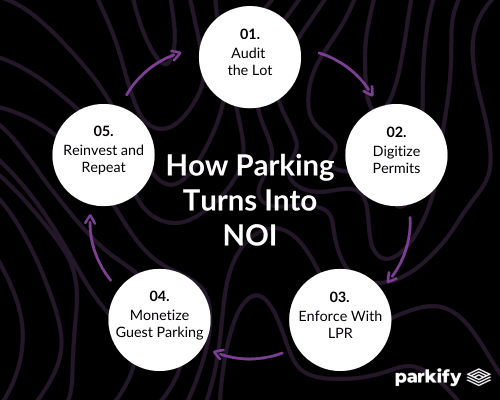
Much of the lost revenue comes from informal arrangements nobody tracks: the extra vehicle that never paid for a second stall, the tenant whose guest parks overnight every night, the permit that expired a year ago. Automated parking enforcement closes those gaps and turns unauthorized parking into either compliance or a paid session.
Monetizing Guest and Visitor Parking
Guest and visitor parking is where multifamily owners leave the most on the table.
"A lot of multifamily properties are sitting on guest and visitor inventory that could be generating revenue 24/7," Copeland notes.
Opening overflow or an underused deck to short term hourly parkers creates a new revenue stream without touching resident spaces. Parkify client TriBridge Residential did exactly that, tapping late-night district traffic to earn revenue from a front lot after the leasing office closed.
Segmenting Resident and Guest Parking
Functional parking policies start by separating two very different populations. Residents are a predictable group with assigned needs. Visitors are high-churn and the usual source of parking problems.
Blend them without structure and residents cannot find parking spots because guests are camping in them. Clear segmentation fixes that with a few defined rules:
Residential permit parking tied to each resident's license plate
Guest permits and temporary permit options for visitors
An overnight parking permit rule that keeps common areas clear
Separate handling for deliveries, electric vehicle charging stalls, and bicycle parking
Well-defined parking regulations protect residents while making guest parking something you can actually charge for.
The Technology That Turns Parking Into NOI
Modern parking management software handles all of this automatically, which makes the NOI gain lasting, not a one-time cleanup.
License Plate Recognition and Enforcement
License plate recognition cameras read every vehicle entering and exiting the lot, so the system always knows who is parked and whether they belong. Enforcement happens without staff walking the parking facility or issuing tickets by hand. Access control works without gates, which removes both the capital cost and the maintenance headache that come with legacy setups.
Digital Permits Instead of Paper
A digital permit is tied to a plate, not a windshield sticker. Residents register once, guests request access in seconds, and every parking permit is verifiable on demand. There is nothing to forge and nothing to file.
Real-Time Data on the Whole Lot
A single dashboard shows occupancy, revenue, and parking availability across the property. That real-time data tells you which parking rules to adjust, when demand peaks, and where additional parking could be monetized. You manage by intelligence instead of by resident complaint.
Zero Upfront Cost Removes the Last Objection
The reason parking upgrades get deferred is usually budget. Parkify deploys with no capex on a subscription or revenue-share model, so the system pays for itself out of the revenue it produces. There is no hardware to buy and no gate to install, which is why most properties go live in under 30 days.
For an owner who kept deferring the upgrade to avoid a capital project, that removes the last reason to wait.
Getting Started
Before rates or technology, audit what you have. Know your stall count, your current utilization, who is actually parking on your residential property, and whether any enforcement exists at all. You cannot optimize what you have not measured.
From there, digitizing permits alone often lifts utilization, and layering in enforcement and guest monetization turns the parking lot into a line item that grows NOI instead of quietly capping it. Multifamily is one of the asset classes Parkify works with most, and the pattern repeats: the revenue was always there, just uncaptured.
Ready to see how much your parking is really worth? Book a free strategy session with Parkify and get a clear read on the NOI hiding in your lot.
Frequently Asked Questions
How does multifamily parking affect NOI? Parking revenue drops almost entirely to net operating income because operating costs stay low once the system is automated. Recovering leaked revenue and monetizing guest parking raises NOI, and higher NOI raises overall property value.
Can I monetize guest parking without upsetting residents? Yes. Separating resident and visitor parking into different zones and rules lets you charge for guest and short term parking while protecting resident stalls. Residents keep their spaces, and the property earns from inventory that used to sit empty.
Do I need gates or hardware to enforce parking? No. License plate recognition and digital permits handle access control and enforcement without gates or kiosks. That keeps upfront cost low and avoids the maintenance issues that come with traditional gate systems.
How long does it take to get a system running? Most multifamily properties go live in under 30 days. Digital permitting and scan-to-pay can be active in days, while camera installation depends on site conditions.
Will residents have to download an app? No. Guests and residents use QR codes and license plate recognition, so there is no app to download and no account to create for parking access.