Rethinking Employee Parking: Modern Alternatives to Office Parking Permits

Short Answer: Traditional office parking permits, including hang tags, permit stickers, and paper applications, create steady admin work and leave money uncollected. Modern alternatives swap that paperwork for a virtual permit tied to each employee's license plate, so people park without anything on the rearview mirror and managers see every parking space in real time. The payoff is cleaner enforcement, fewer disputes, and a parking program that finally turns a profit.
The Real Cost of the Traditional Employee Parking Permit
For decades, employee parking has run on the same playbook. A worker fills out a parking permit application at the parking office during business hours, hands over their vehicle information, and walks away with a hang tag or permit sticker for the rearview mirror. Payroll deduction covers the monthly parking fee, and everyone moves on.
That works until it doesn't.
Physical permits get lost, shared, or left at home. Enforcement depends on someone walking the parking lot to check for a valid permit, which rarely happens consistently. At the same time, the parking office keeps fielding questions about replacement tags, temporary permit requests, and parking assignment changes that stack up week after week.
Where the Money Leaks
A paper-based parking program hides its costs. A few patterns repeat at almost every property:
Employees who never had a valid permit still get free parking, because no one checks plates against the permit holder list.
Visitor parking goes untracked, so guest spaces fill with staff cars and no parking fee is collected.
Manual records make real space availability hard to confirm, which leads to oversold lots and frustrated drivers.
As Morgan Copeland, COO at Parkify, puts it:
"We also see a lot of clients surprised by how much legitimate revenue was being lost to informal arrangements: the tenant letting their friends park for free, the employee who never actually had a permit. The system creates accountability, and that has a dollar value."
What Rethinking Employee Parking Looks Like
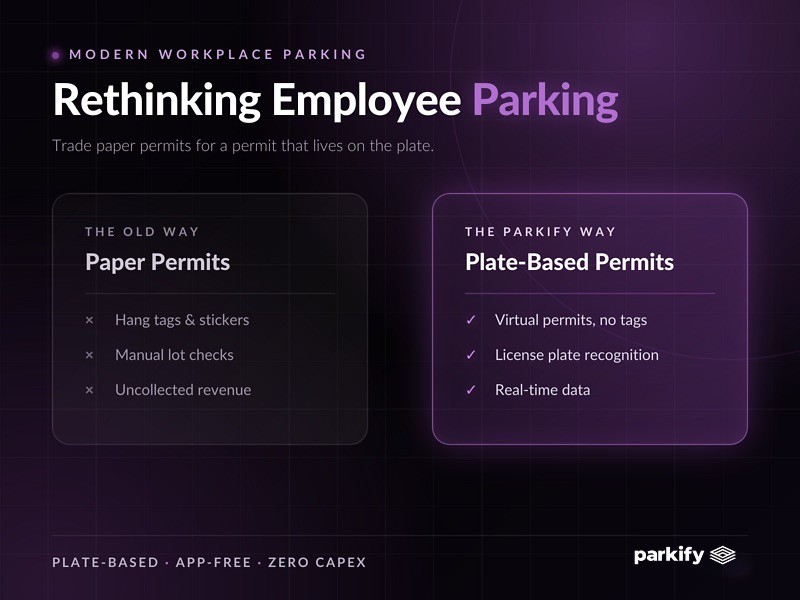
Rethinking employee parking does not mean adding another app or writing a stricter rulebook. It means replacing the physical permit with a digital record that does the same job with far less friction. The employee's license plate becomes the permit.
"The death of the permit as we know it" is how Copeland describes the trend. "Static, paper-based, annual permits are a relic." In their place comes a virtual permit that lives in the cloud and ties to a license plate number rather than a piece of plastic on the dash.
Modern Alternatives to Office Parking Permits
Virtual Permits Tied to a License Plate
A virtual permit assigns parking rights to a vehicle's plate instead of a hang tag. The employee registers their vehicle information once, and that record handles their parking assignment from then on. There is no permit sticker, no trip to the parking office, and no replacement fee when a tag goes missing. Updating a plate or adding a second vehicle takes seconds.
License Plate Recognition for Hands-Off Enforcement
License plate recognition cameras read every plate entering and leaving the parking facility, then check it against the list of permit holders automatically. A car without a valid permit gets flagged on its own, so a parking violation no longer depends on a staff member patrolling the lot. Enforcement runs around the clock instead of only during business hours.
QR Code Access Without an App
Visitors and short-term parkers scan a QR code, enter their license plate, and pay by credit card in seconds. There is no app to download and no kiosk to maintain. A time limit caps how long a visitor stays, which keeps visitor parking moving and collects the parking fee informal setups usually miss.
Flexible Parking Options for Every Driver
One arrangement rarely fits a whole workforce, so modern parking services support a mix of options in the same lot:
Monthly parking and monthly permit billing handled through payroll deduction
Temporary permit access for contractors, interns, or a visiting downtown employee
Reserved spots alongside general first-served basis spaces
Separate visitor parking rates that protect employee parking spaces
Why Employers and Property Managers Come Out Ahead
The biggest gain is visibility. A live dashboard shows real space availability, revenue, and enforcement activity across the parking lot, replacing guesswork with numbers. Managers can pull a digital parking map, see which parking areas sit empty, and adjust parking rates without reprinting a single permit.
Administration shrinks at the same time. The parking office stops processing paper applications and chasing stickers, and employees stop emailing for additional information about lost tags. Because access ties to the plate, the parking rules enforce themselves.
There is a revenue side too. Dynamic pricing lets owners move parking fees with demand, and spaces recovered from unauthorized cars can be sold as monthly parking or opened to the public after hours.

Making the Switch Without the Headache
Moving off physical permits is lighter than most teams expect. With a zero upfront cost model, there is no hardware to buy, and most properties go live in under 30 days. Plate cameras and QR signage replace the old permit workflow, the team learns one dashboard, and employees keep parking as always, just without the tag on the mirror.
The technology stays in the background. Owners keep control of pricing, parking assignment, and transportation services decisions, with full data instead of a monthly report from a third-party operator.
Ready to retire the hang tag? Book a free strategy session with Parkify and see how a plate-based parking program can cut admin work and grow revenue at your property.
Frequently Asked Questions
What is a virtual employee parking permit?
A virtual permit links parking rights to an employee's license plate instead of a physical hang tag or permit sticker. The vehicle information is stored digitally, so the plate itself acts as the valid permit and there is nothing to display on the rearview mirror.
How does license plate recognition enforce employee parking?
LPR cameras capture each license plate number entering the parking facility and compare it to the list of permit holders. Any vehicle without a current parking permit is flagged automatically, which makes parking violation tracking consistent without staff patrolling the parking lot.
Can employees still pay through payroll deduction?
Yes. Monthly parking and monthly permit fees can run through payroll deduction just as before. The only change is that the parking assignment ties to a plate rather than a sticker, so there is no permit to pick up or renew in person.
How is visitor parking handled without permits?
Visitors scan a QR code, enter their plate, and pay the posted parking rates by credit card. No app or parking permit application is required, which keeps visitor parking separate from employee parking spaces and captures revenue that often slips through.
Do we need a parking management company to run it?
No. The platform lets property managers handle parking options, parking rates, and enforcement themselves from one dashboard, without handing control or revenue to a third-party parking management company.