Staff Parking Management: A Practical Guide for Facility Managers
Short Answer: Modern staff parking management replaces paper hangtags, clipboard logs, and aging pay-on-foot machines with virtual parking permits and license plate recognition. Facility managers can now run the whole operation from a parking portal without hiring a third-party parking management company or sinking capital into new gates and kiosks.
Why Staff Parking Is Harder Than It Looks
On paper, faculty and staff parking should be straightforward. You have a parking lot, a list of staff members, and a finite number of parking spaces. In practice, every facility manager knows the day-to-day reality looks different.
Permits get lost. Cars rotate between drivers. New hires need access on day one, and the parking office is already buried in waiting list requests. Add a parking citation dispute or a broken pay-on-foot machine, and a single morning can swallow half a workday.
Most of these problems trace back to two issues: outdated hardware and manual paperwork. Fixing those two pieces tends to fix everything downstream.
The Hidden Costs of Legacy Parking Hardware
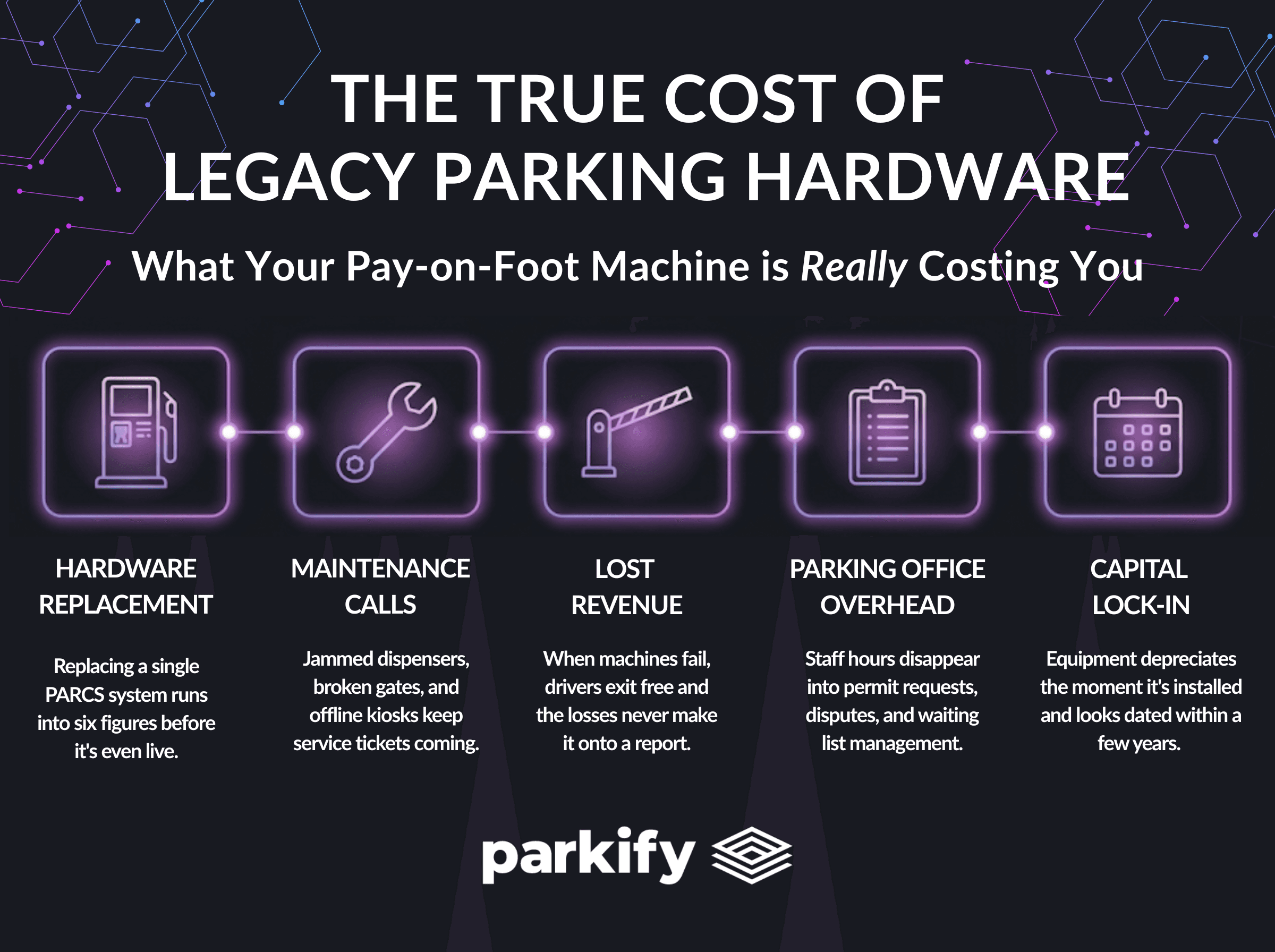
If your parking facility still runs on pay-on-foot machines, ticket dispensers, or magnetic-stripe gate cards, the receipts may surprise you.
Maintenance Eats the Budget
Pay-on-foot machines fail in the rain. Ticket spitters jam during the morning rush. Gate arms snap when a delivery truck clips them. Each failure means a service call, parts, and downtime while your parking lot loses revenue. Industry research consistently lists hardware maintenance as one of the largest line items in any traditional parking operation.
Lost Revenue You Never See
When a pay-on-foot machine goes offline, drivers leave without paying. When a gate stays open after a malfunction, the parking facility runs as a free lot until someone notices. Without real-time tracking, those losses never show up on a report.
Capital Expense You Can't Recover
Replacing a single PARCS system can run six figures, and the equipment depreciates the moment it's installed. For a facility manager trying to defend the next budget cycle, that's a hard number to justify, especially when the technology will look dated again within five years.
What a Modern Staff Parking System Looks Like
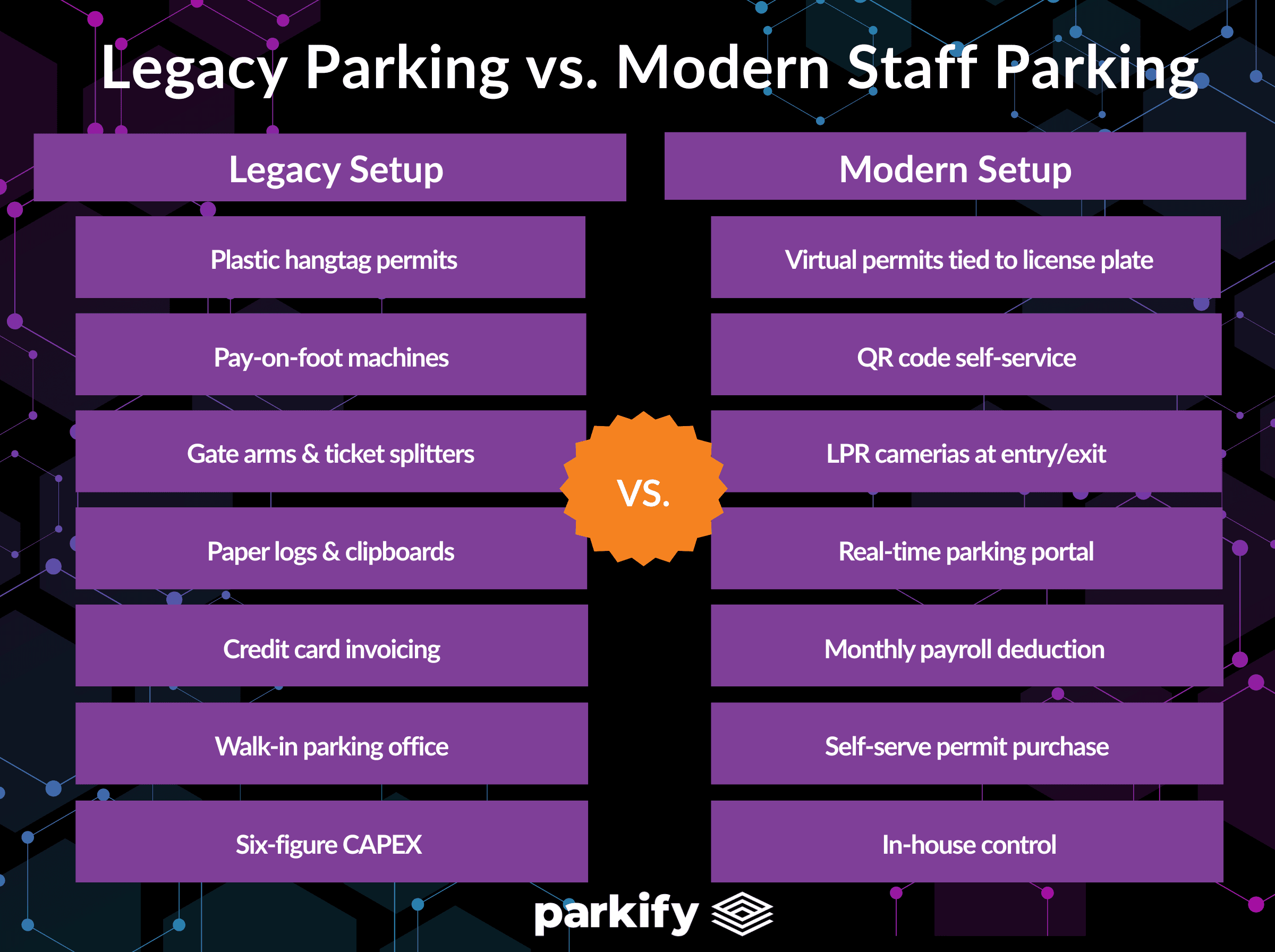
The shift away from legacy hardware doesn't require a bigger budget. It requires different tools.
Virtual Permits Replace Plastic Hangtags
A virtual parking permit is tied to the vehicle license plate, not a physical tag hanging from the rearview mirror. When a permit holder pulls into the parking lot, cameras read the plate and verify the staff parking permit is active.
That means no permit reprints, no permits forgotten at home, and no permits shared between drivers who shouldn't be sharing them. Vehicle information lives in the parking account, and updates happen instantly through the parking portal.
License Plate Recognition Handles the Rest
License plate recognition cameras at entry and exit points check every vehicle against your active permit list in real time. A valid parking permit grants access automatically, while an expired or unrecognized plate triggers an alert. The same system tracks daily parking for visitors, contractors, and anyone using a temporary permit. No app downloads, no codes to type in.
Payroll Deduction Simplifies Billing
Instead of chasing credit card payments or printing invoices, set up monthly payroll deduction for eligible faculty and staff. The payroll deduction permit pulls permit fees directly from each paycheck, and the parking account updates without anyone touching it. This works for a monthly parking permit, an annual parking permit, or a quarterly permit. The math runs in the background, and HR gets a clean report every cycle.
Permit Types That Fit Your Workforce
A good staff parking program isn't one-size-fits-all. Different roles need different access, and a flexible system gives you room to tailor each one.
Common permit types worth offering:
Annual permit for full-time staff members on a fixed schedule
Monthly permit or quarterly permit for contractors and rotating roles
Carpool permit with discounted permit costs for two or more riders
Motorcycle parking permits for designated zones
Temporary permit for new hires during onboarding or visiting faculty
Each permit type can map to specific staff spaces, zones on your parking map, or time-of-day rules. A faculty permit might cover lots A and B during business hours, while an evening shift permit unlocks a different parking location after 5 p.m.
When a permit purchase happens through the parking portal, the staff member uploads their vehicle license plate, picks a billing method, and gets confirmation in seconds. No trip to the parking services office required.
Running Operations Without a Parking Office
Many campuses still run a physical parking office to handle permit purchases, replacements, and disputes. That's a real cost in salaries, square footage, and lost productivity for everyone waiting in line.
A modern parking portal moves most of that work online:
Staff register vehicle information themselves
Carpool partners link their accounts together
Permit holders update plates when they buy a new car
Waiting list requests queue automatically as parking assignments open up
For the facility manager, the dashboard shows live occupancy, revenue by permit type, parking rules violations, and additional information on every transaction. That's the kind of visibility a clipboard can't deliver.
The Parkify Approach: No CAPEX, No Outside Operator

Parkify was built for owners who want to run staff parking themselves without a parking management company taking a cut of every dollar. The full technology stack arrives with zero upfront cost, which means no PARCS purchase, no kiosks to install, and no five-year payback math to defend to leadership.
The platform handles AI-driven rate optimization for guest parking, LPR cameras for permit verification, QR code self-service for daily parking, real-time tracking, and direct integration with payroll for deduction-based billing.
Implementation typically wraps in under 30 days, and your team keeps full control of parking rules, permit costs, and parking assignment logic.
If your team is ready to retire the pay-on-foot machine and run staff parking like the rest of your facility operations, book a free strategy session with Parkify and see what the modern playbook looks like.
Frequently Asked Questions
Do staff need to download an app to use a virtual parking permit?
No. Virtual permits work through license plate recognition, so the camera reads the plate at entry. For one-off guest parking or daily parking, a QR code on signage handles payment by credit card without any app install.
Can we offer a carpool permit or motorcycle parking permit?
Yes. The system supports any permit type your campus needs, including carpool permits, motorcycle parking, quarterly permits, and temporary permits for new hires or visitors. Each permit links to specific parking spaces or zones on your parking map.
What happens to our existing pay-on-foot machines and gates?
You can retire them. Parkify replaces legacy hardware with cameras and QR signage, so no more service calls, jammed ticket dispensers, or broken gate arms. Most properties go live in under 30 days.
Do we still need a parking management company to run day-to-day operations?
Not for most setups. The parking portal lets your in-house team handle permit assignments, waiting list management, parking rules, and reporting from one dashboard. That removes a recurring cost most owners didn't realize was negotiable.