How Smart Parking Systems Support Building Access Control

Short Answer: Smart parking systems and building access control run on the same backbone: license plate recognition, mobile credentials, and cloud-based platforms. When the parking lot is connected to your access control system, every vehicle becomes a verified entry point, and your property gains a layer of physical security long before anyone reaches an exterior door.
The Parking Lot Is Your First Access Point
Most security conversations start at the front door. Card readers, key cards, facial recognition, video surveillance, the whole stack. But the actual first access point on your property isn't the lobby. It's the parking lot.
If a vehicle can roll into your lot unchecked, sit there for hours, and leave without anyone logging it, your perimeter has a quiet hole in it, with that same logic applying whether you're protecting a single building or dozens.
Modern parking technology closes that gap by treating the parking lot as part of your broader access control solution, not a separate problem.
Why Legacy Parking Hardware Undermines Security
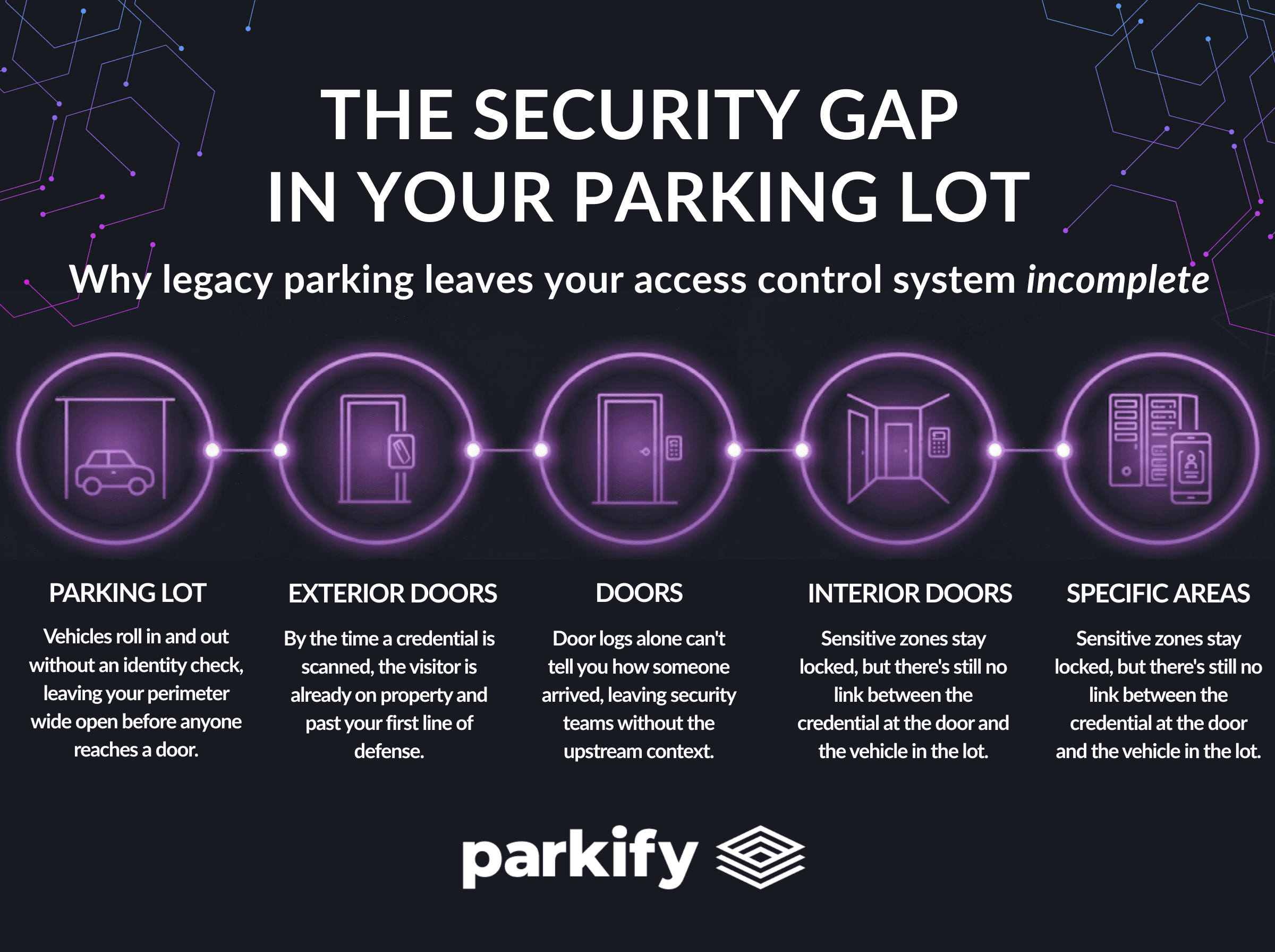
Pay-on-foot machines, ticket dispensers, and gate arms, known in the industry as PARCS (Parking Access and Revenue Control Systems), were built for billing, not for tracking who actually entered the property.
No Real Identity Layer
A paper ticket does not know who is holding it. A pay station does not talk to your electronic access control system. If a vehicle enters and the gate opens, the only record is a ticket stub. That's not access control. It's a turnstile.
Hardware Fails at the Worst Times
When a pay-on-foot machine goes down, properties usually default to leaving the gate open until repairs arrive. That decision keeps cars moving but turns the whole parking facility into an unmonitored zone for hours or days. Anyone can come and go without trace. That is not an argument against the gate itself. A visible barrier still plays a role in deterrence, especially at airports, hospital campuses, and gated residential properties where drivers expect a controlled entry. The problem is the billing hardware behind the gate, not the gate itself.
Costly to Maintain, Slow to Update
Legacy hardware needs the lock shop, the parking vendor, and often a third party for the access control device tied to the gate. Updating permissions takes phone calls and paperwork. By the time a new staff member or contractor is added to the system, business hours have already ended.
The hidden costs are not just dollars. They are delays in the approval process, blind spots in your records, and gaps your security systems cannot see.
How Smart Parking Integrates with Access Control
The shift from legacy parking to a modern parking system mirrors what's already happened with electronic access control inside buildings. Both the infrastructure and the benefits are shared.
License Plate Recognition Replaces the Gate Ticket
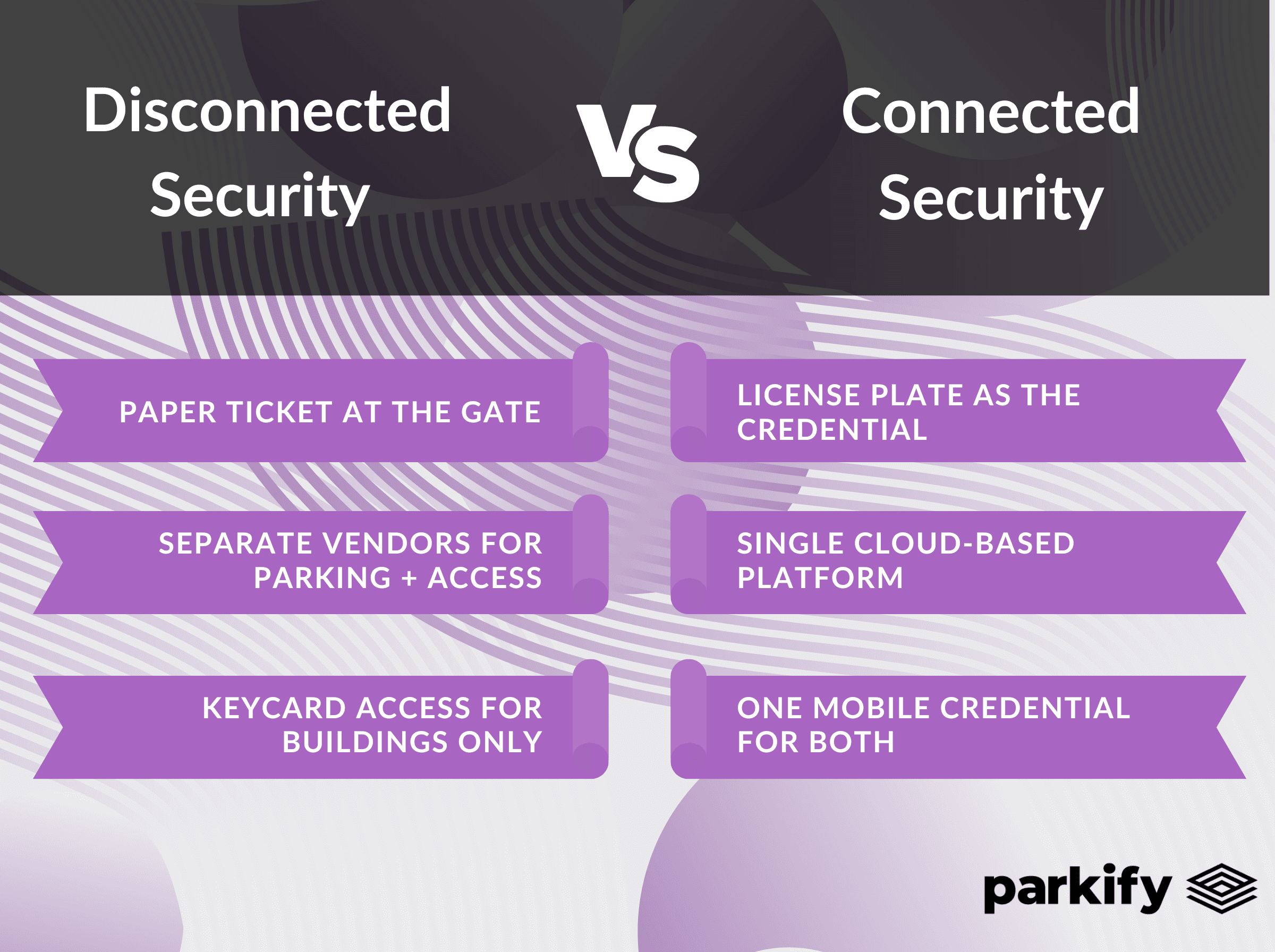
LPR cameras read every plate that enters and exits the parking lot in real time. The plate is the credential. Just as a card reader checks an access card against the access control system, the camera checks the vehicle license plate against your permitted list. That record gets timestamped, logged, and made available to the responsible department.
If police or security need to review activity, the data is searchable in seconds, not pulled from a dusty ticket archive.
Mobile Credentials Cover Cars and Doors
The same mobile credential that lets a faculty member open an interior door through a mobile app can also be tied to their parking account. One sign-in, one identity, one record. No separate access card for parking and another key card for campus buildings.
For property managers, this consolidation simplifies onboarding and offboarding. When someone leaves the organization, revoking access permission removes them from both the parking lot and the building's electronic card access in a single action.
Cloud-Based Platforms Talk to Each Other
Cloud-based access control systems and cloud-based parking platforms share a common architecture, which means they can integrate cleanly. Activity from the parking lot can feed your security dashboard alongside data from card readers, video surveillance feeds, and other access control devices.
That gives security teams a fuller picture of who is on property and where they are at any given moment.
Where This Matters Most
Smart parking integrations support physical security across a range of property types, but the use cases sharpen in a few specific environments.
Higher Education Campuses
University buildings, residence halls, and academic facilities all run on layered access. Students, faculty, staff, contractors, and visitors each need different access permissions at different times. Tying the parking lot into the same access control solution lets a department head approve a guest's access request once, and the access flows through to both the parking facility and the specific areas of campus the visitor is cleared to enter.
If a vice president is hosting an event, attendees can be added to the system for a single evening without issuing physical access credentials or paper passes.
Residential and Mixed-Use Properties
For multifamily buildings, the parking deck is a gateway to the lobby and elevators. Connecting parking access to the building's access control system means residents don't carry separate fobs for the garage and the front door. It also means property managers can spot unusual patterns, like a vehicle entering during off hours, before they escalate into actual potential threats.
Airports and Transportation Hubs
Airports are one of the clearest cases for keeping the gate while modernizing what's behind it. Travelers expect a visible, controlled entry into long-term and economy lots, and the physical barrier is part of the security signal the facility sends to drivers, staff, and law enforcement alike. Pulling the gate would feel like loosening the perimeter, even if the underlying technology is stronger.
What changes is the brain behind the gate. LPR cameras read every plate at entry, the cloud-based platform verifies the booking or permit in real time, and the gate opens without a paper ticket changing hands. For frequent flyers and airport staff, the same mobile credential can cover parking, terminal access points, and back-of-house areas. The sense of security stays intact, the friction goes away, and security teams gain a searchable record of every vehicle that touched the property
Corporate Campuses and Healthcare
Office parks and hospital campuses often span multiple buildings with shared lots. A single access control device tied into a connected parking system lets security teams see vehicle activity across all access points, not just the main entrance. That visibility is hard to build with legacy hardware and easy to build with cloud-based access control paired with LPR.
What a Modern Setup Looks Like in Practice
For a property considering this kind of upgrade, the picture is simpler than most owners assume:
LPR cameras at every entry and exit
QR code self-service signage in place of pay stations
A mobile app or web portal for permit management
Direct integration with the building's existing access control system
Real-time logs accessible to the responsible department
No app downloads required for visitors. No new key card stack for community members. No 24-month CAPEX cycle for new gates. Parkify walks through the rollout and shows the difference between this approach and traditional setups.
Retiring the Pay-on-Foot Machine
The hidden costs of legacy parking hardware extend past maintenance bills. Every minute that machine sits between the parking lot and your access control system is a minute your property runs with two disconnected security postures. Modern solutions consolidate them.
Owners who make the switch typically see three things happen at once: parking revenue goes up because nothing slips through the cracks, security visibility goes up because every plate is logged, and operating costs go down because there's no more lock shop run for a broken gate arm.
If your property still relies on pay stations, plastic permits, and a separate access control vendor for everything beyond the lobby, book a free strategy session with Parkify and see what a connected setup looks like.
Frequently Asked Questions
Does Parkify replace our existing access control system?
No. Parkify works alongside your current electronic access control system, sharing data through standard integrations. Your card readers, video surveillance, and interior door hardware stay in place. The parking lot becomes another layer in the same security solution.
Do users need a mobile app to access parking and buildings?
Not necessarily. Visitors and short-term guests use QR codes with no app required. Staff and residents who already use a mobile credential for building access can tie the same identity to their parking account if your access control solution supports it.
How does this protect personal information?
Plate data and access logs are stored in a cloud-based platform with the same security standards used by modern access control systems. Personal information is limited to what's needed for the parking account, and access is restricted to authorized roles.
Can we control access for specific areas or buildings only?
Yes. Permits and access permissions can be scoped to a single building, a specific lot, or particular access points. A contractor working on one residence hall, for example, can be cleared for that lot and that exterior door without gaining access elsewhere on campus.
What happens to our pay-on-foot machines and gate arms?
The pay-on-foot machines come out. The gate can stay if it adds a sense of security at your property, which is often the case for airports, hospitals, and gated communities. Parkify replaces the billing hardware with LPR cameras and QR signage, and the gate opens on a verified plate instead of a paper ticket."